The Netherlands - Resilient, but not immune

Solid foundations, the unique position in the semi-conductor supply chain and government spending have helped the Dutch economy withstand another energy shock. Growth is expected to moderate in 2027–28 as higher interest rates and inflation weigh on demand, despite continued support from exports. Inflation will remain persistent, while supply bottlenecks limit the economy’s growth potential.


Why has Dutch economic growth held up?
The Dutch economy proved remarkably resilient in 2026. Another energy shock hit while households and firms were still absorbing the effects of the previous one. Yet activity held up, supported by household finances and private consumption, AI-related export demand, and government spending. The solid growth figures seen in 2026 provide a foundation for 2027 but are not a shield against every headwind. Our growth forecasts for 2026 and 2027 are now just above where they were before the outbreak of the war. Why have we seen solid growth so far, despite geopolitical uncertainty, higher energy prices and resulting inflation? First, wage growth has outpaced inflation, lifting real incomes, and the tight labour market has supported confidence to spend those gains despite global uncertainty. Indeed, private consumption has been solid despite inflation. Specific income groups have seen further purchasing-power gains. Pension reforms have increased spending power among older households and are likely to provide a small further lift to consumption in 2028 (read here). Private-sector balance sheets have become more resilient as debt ratios have continued to decline. The household savings rate remained elevated in recent years amid uncertainty, while financial buffers help consumers absorb higher costs. Second, strong AI-related demand has supported exports from the Dutch semiconductor sector and its suppliers. Machinery manufacturing, which includes several major companies in this sector, increased its value added by 70% between 2019 and 2025. Compared to H1 2025, its value added continued to grow by another 13% in H1 2026. Third, government spending has supported growth. Think for instance of rising spending on healthcare due to greying. Also, despite plans to reduce ministry staffing, employment across the wider public sector continues to expand, giving public spending a substantial role in the growth mix (see left chart below).
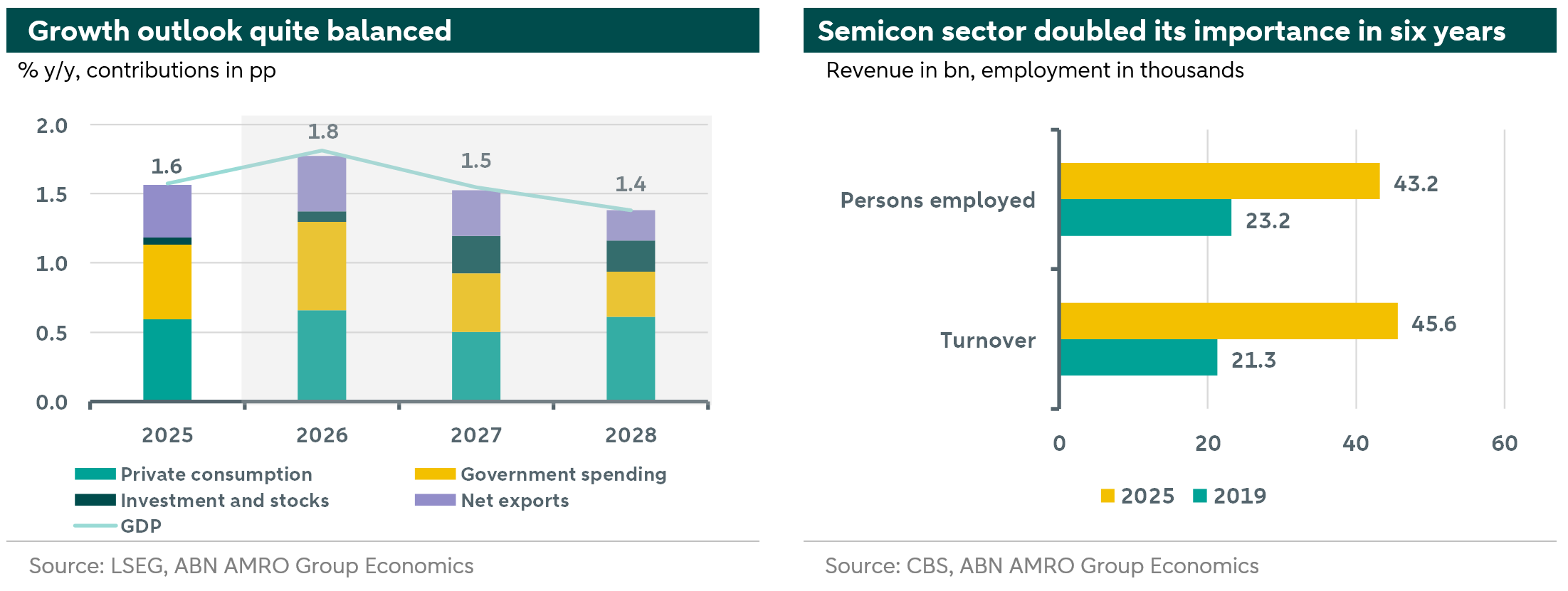
Headline growth solid but cyclical headwinds lead to some moderation
We expect growth to moderate in 2027 and 28. Higher interest rates are already weighing on activity, particularly in the housing market, where we expect transactions to decline in 2027 (read here). Higher inflation will result in a smaller impulse from consumer spending throughout the year, as households see inflation picking up; particularly in the very ‘tangible’ food prices (see below). Exports offer a mixed picture. AI-related demand continues to support the Dutch semiconductor sector, and several major companies in this sector have recently raised their expectations for 2027. Energy-intensive industrial exporters, however, face ongoing competitive pressure despite planned government compensation for electricity costs. This weighs on export demand. Stronger growth in Germany, the Netherlands’ largest trading partner, provides another source of support. German fiscal spending, including investment in defence and infrastructure, is expected to benefit Dutch activity, while also putting strain on scarce capacity in the Western-European infrastructure sector. But resilience is not the same as greater capacity to grow. Electricity-grid congestion, nitrogen-related restrictions and other supply constraints are increasingly limiting long-term economic growth.
Inflation to be above 3% for sixth year in a row
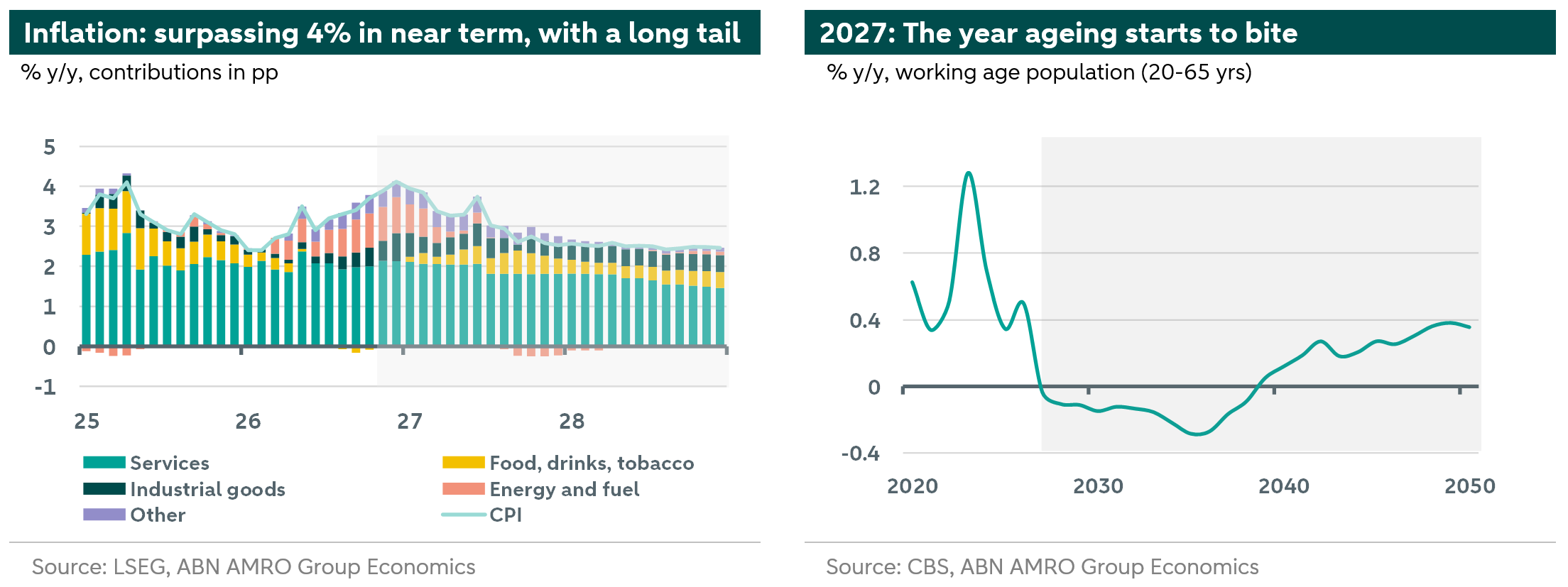
The latest energy shock is likely to leave a longer inflation tail in the Netherlands than in other eurozone economies. It arrived while wage growth and underlying inflation were still elevated. Core CPI inflation was still 2.7% in February. Like the eurozone aggregate, we therefore expect both inflation and wage growth to remain elevated for longer (read here). Fixed household energy contracts in the Netherlands slow the pass-through of price increases to inflation but may prolong energy inflation if the shock persists. While global energy prices are expected to cool into 2027 and 28, three channels will keep price pressures alive. First, higher energy costs will continue to feed into other prices, notably food. After a hold this year from several years of strong increases, food prices are expected to pick up again in 2027, also reflecting higher global commodity prices. Second, higher consumer-electronics prices will contribute to goods inflation, partly reflecting rising computing costs and global scarcity. Third, services inflation is expected to ease only slightly over the coming years, partly because of wage growth and since rents are automatically indexed. Policy measures, including fuel levies and the passing on of ETS2 costs, will also affect inflation. Taken together, these factors underpin our forecast of 3.2% inflation in 2027 and 2.5% in 2028, following an average of 3.2% in 2026.
Labour market: headline steady, slight weakening underneath.
The unemployment rate has held at 4% for three consecutive months, and the labour market remains tight overall. Beneath that stable headline, however, several indicators point to slight easing; for instance a decline in vacancies per unemployed and a rise in short- and long-term unemployment. We expect unemployment to edge up, averaging 4.1% in 2027 and 4.2% in 2028. Still, the greying Dutch working age population adds to tightness. Demand from the public and semi-public sectors remains strong and accounts for a growing share of total new labour demand. Meanwhile, measures to prevent false self-employment are reshaping employment: fewer people are choosing self-employment, while more are moving into employee contracts. We expect this shift to continue in 2027.
Minority cabinet fails to provide much-needed stability so far
In our global outlook of last year, following the early collapse of the Schoof 1 government and extensive period caretaker governments we wrote that the incoming Jetten 1 cabinet, albeit with minority status, could provide more stability. This has not been the case so far. A prime example is the 2027 tax plan, the first full year tax plan of the Jetten cabinet. At the time of writing a majority for the 2027 tax plan has yet to be found. It shows how difficult it is for a minority cabinet to pass legislation. This new experiment where a cabinet with minority status struggles passing legislation follows a continuation of a period where since 2020, the Dutch government had caretaker status for roughly 40% of the time. This is unwelcome for a country where headline growth may be strong, but potential growth is worsening, and labour productivity (while increasing lately again) as well as the many supply-side bottlenecks need addressing. While the coalition agreement featured many steps in the right direction on innovation, education and on these bottlenecks, 2027 will show whether the government finds majorities to take these plans into action. The provincial elections (March 27), which determine the make-up of the Senate will be a new test for the government.
All in all, the Dutch economy has shown its capability of absorbing shocks which provide a solid foundation heading into 2027. Various factors support current activity, but they do not remove binding supply constraints. Expanding capacity to grow in the longer term is a different challenge.