US - The energy shock fades, the AI boom doesn’t

Investment will keep driving growth in 2027, consumers keep up as falling inflation lifts real incomes. The energy shocks will fade without second round effects, the AI build-out keeps core inflation elevated. After one last hike in December, the Fed holds through most of 2027 before easing late in the year

Growth: Investment will lead, can consumers keep up?
Investment remains the engine of the US economy. Spending on IT equipment and software, most of it for AI, has contributed about 1pp a year to GDP growth since 2025, and 1.1pp of the 3.4% growth in the third quarter. We expect AI capex growth to slow from more than 70% to around 40% in 2027. Even so, spending will continue to rise strongly, while defence procurement provides a second source of demand. Defence equipment's high domestic content means less of this demand will leak into imports than with AI hardware, so capex should keep adding to growth at roughly this year's pace. Our analyses put the combined impulse from AI, defence and clean-energy investment at about 1.6% of GDP in 2027.Outside these areas, tighter corporate and consumer credit conditions point to a weaker outlook: we expect other business investment to soften gradually and housing to remain a drag.
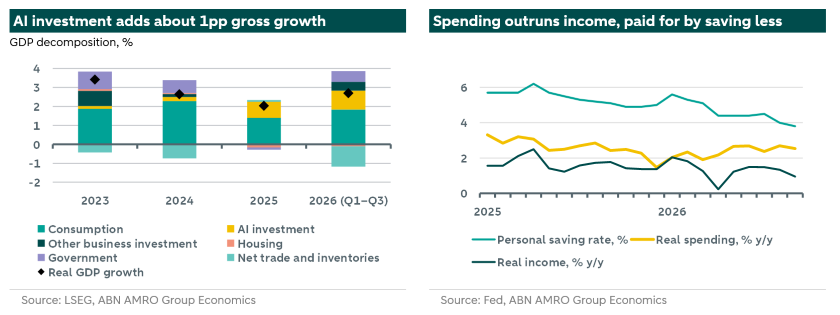
Consumption is dependent on an improvement in real incomes. Real spending was 2.5% higher in September than a year earlier, but real disposable income rose only 0.9%. Households bridged the gap by saving less, bringing the saving rate down to 3.8%. In 2027, we expect consumption to rely more on real income gains and less on further declines in saving. Nominal labour income should grow by about 3.5%, with wages rising around 3% and employment by 0.3–0.5%. As oil prices fall, we expect headline PCE inflation to decline from 3.6% to around 2% by late 2027, supporting households' purchasing power. The relief comes from slower price growth, not stronger wage gains. With the labour force barely growing, growth relies on productivity, which has held up at 2.2% a year. As in 2026, however, we expect AI's main contribution to growth in 2027 to come from investment in the technology rather than productivity gains from its use. Sustaining growth and living-standard gains beyond the build-out will therefore require those productivity benefits to emerge as capex growth slows.
Politics: What a Democratic Congress means
Democrats won both chambers in the midterm elections, but still fell far short of the two-thirds needed to override a veto. The result is gridlock, which impacts the economy in two ways. Fiscal uncertainty falls, because there will be no new partisan tax or spending packages. Policy uncertainty does not, because trade and foreign policy, tariffs included, stay with the President. We assume tariffs stay broadly stable. Budget and debt-limit deadlines will be the main fiscal flashpoints. Democrats could use them to push for restoring the healthcare subsidies the administration cut, a small but real support for the lower-income households that are already squeezed. At the same time, Democratic control of Congress limits the administration's ability to push through further spending increases. In particular, additional defence spending through reconciliation would now require Democratic support, reducing the upside risk to our defence capex outlook.
Inflation: The energy shock will fade, AI keeps some heat in
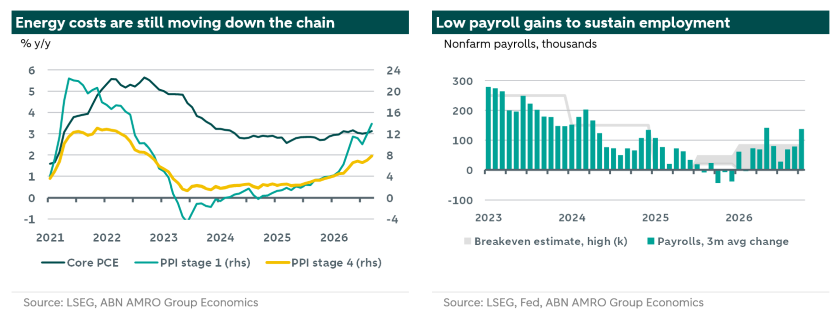
The energy shock is past its peak. The question is whether this was a one-off commodity shock or a cascade that keeps generating inflation through wages and expectations. Producer price indexes by stage of production help track the remaining pipeline pressures. Stage 1 input prices, where energy has the largest weight, were 13.9% higher in September than a year earlier. Stage 4 input prices, closest to final demand, rose 7.8%, compared with about 3% a year ago. This suggests that cost pressures are still working through the supply chain, helping to keep core PCE inflation close to 3% into early 2027. However, the evidence points to a relatively narrow transmission: stage 3 inflation has converged with stage 4 after exceeding it in the spring. Pressures are concentrated in energy-sensitive freight and chemicals, while final-demand services outside trade and transport are rising at a steady 4%. We see little evidence of broad second-round effects. Wage growth is slowing rather than catching up with inflation: wages and salaries in the employment cost index rose 3.1% in the year to the third quarter and 0.7% in the quarter itself, while headline PCE inflation was 3.6% year on year. Market-based long-term inflation compensation is also stable: the 5y5y breakeven inflation rate is 2.2%, unchanged from a year ago. Higher consumer inflation expectations remain a risk. The AI build-out keeps PCE inflation above target. Prices of information processing equipment were 15.7% higher in September than a year earlier, and we expect pressure in this area to persist while the build-out continues. Our forecast is for core PCE inflation to ease only gradually, from 3.1% now to around 2.4% by the end of 2027. Headline PCE inflation falls faster as energy prices drop, from 3.6% now to about 2% by late 2027.
Labour market: The new arithmetic of payrolls
The monthly increase in payrolls needed to keep unemployment stable has fallen sharply. Estimates of this breakeven pace have declined from about 250,000 in 2023 to below 50,000 now, with some Fed estimates close to zero. Demographics should keep the breakeven pace low in 2027. Overall labour force participation fell from 62.5% to 61.8% over the past year, while prime-age participation held at 83.7%. With the "Peak 65" retirement wave continuing through 2027 and immigration low, we expect labour force growth to remain close to zero. Monthly payroll gains of 20-50k therefore consistent with stable unemployment, and a single negative month would not, by itself, signal recession. Recent payroll gains have been stronger, averaging 137k a month over the past three months and extending across more sectors than last year. This suggests firmer labour demand, but low labour supply growth means that these gains need not continue at that pace to keep unemployment stable. We expect unemployment to remain broadly stable at 4.3-4.4% through 2027.
Fed: One more hike, then the start of easing
We expect the Fed to raise rates once more in December 2026, to 4.00-4.25%. With core PCE inflation at 3.1%, we expect it to prioritise guarding against persistent inflation rather than immediately looking through the energy shock. Markets price further tightening, with the upper bound peaking at 4.6%. Our view is that one additional hike will be sufficient, followed by a hold through the first three quarters of 2027. A higher neutral rate makes this stance less restrictive than the nominal rate alone suggests. We estimate that the AI build-out is lifting the neutral real rate by about 0.2pp while it lasts, putting the nominal neutral rate at 3.3-3.6%, above the Fed's own estimate of 3.2%. At 4.00-4.25%, policy sits about 0.5-0.8pp above neutral: tight enough to prevent second-round effects, without unduly weakening the broader economy. The trigger for the first cut is core PCE inflation moving convincingly in the right direction. IT goods inflation will likely stay high through the build-out. But by late 2027 the Fed should be convinced that the energy shock has not passed through to wages and expectations, and that the pressure from IT goods is narrow enough not to warrant tightening across the whole economy. With core PCE inflation back at around 2.4% by then, we expect a first cut in December 2027, to 3.75-4.00%. The uncertainty runs both ways: broad second-round effects or a renewed oil spike would bring another hike instead, while an AI correction or a weaker labour market would bring cuts forward.