China - The world alone is not enough

GDP growth in 2026 supported by spillovers from global AI boom, but imbalances have worsened. Ongoing targeted, piecemeal support expected to safeguard GDP growth in 2027. The Six Networks scheme should contribute to a turnaround in investment. Despite hiccups, we do not expect trade relations with US/EU to spiral out of control next year. We expect annual real GDP growth to remain around 4.5% in 2027 and 2028.

Looking back at 2026: GDP growth supported by global AI/tech boom spillovers…
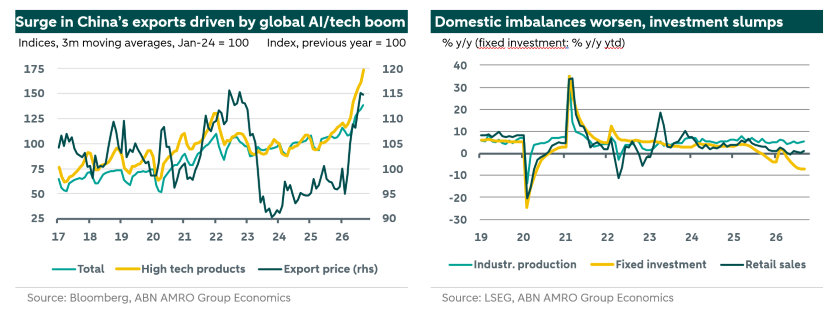
Real GDP growth held up quite well during 2026, despite drags from the Iran war and the related energy crisis and domestic demand weakness. After a strong start in Q1 (5.0% y/y), real GDP growth slowed in Q2 (4.3%), but recovered somewhat in Q3 (4.5%, in line with our forecast) driven by exports and a recovery in oil refinery output. We expect full-year growth of 4.6% in 2026, at the lower end of Beijing’s 4.5-5.0% target zone. Still, growth was again lopsided this year, with domestic supply-demand imbalances worsening. The supply side was bolstered by the global AI/tech boom. Industrial production growth remained solid throughout the year despite the Iran conflict and other disturbances. Export values – and in its slipstream import values – surged, although this was not only driven by AI related products (with car exports booming), while the strength in foreign trade is also explained by higher export and import prices.
…but domestic supply-demand imbalances have worsened, stoking trade tensions
By contrast, domestic demand remained subdued throughout 2026 so far. The Chinese consumer is still cautious and keeps saving and/or deleveraging, with consumer confidence affected by the ongoing property slump (although with some signs of easing), a weak labour market, softer income growth, and limited safety nets. Retail sales keep lagging industrial production by a wide margin, with durable goods, including cars, particularly weak. Investment returned to contraction territory; this is still driven by the property slump, but investment in manufacturing and infrastructure also turned negative. This investment decline party reflects more stringent rules (e.g. anti-involution and corruption campaigns) and more challenging financial positions for many local governments, which traditionally play an important role in public investment plans. These imbalances and the resulting overcapacity feed into higher external surpluses and trade frictions (see below). Demand weakness is also reflected in ongoing low CPI inflation, although PPI inflation has risen, led by higher energy prices. That said, China digested the energy shock well, partly reflecting a switch to other energy sources (electricity, coal). In fact, China emerged as ‘global swing consumer’ of oil, although it has occasionally cut back oil refinery production and imposed export restrictions – with spillovers to global markets.
Ongoing targeted support expected to safeguard GDP growth in 2027
We assume the growth contribution from net exports to soften next year, as trade partners like the EU (see below) take further measures to contain certain imports (like cars) from China, and the global AI/tech boom loses some steam. This implies that policymakers will have to do more to safeguard overall GDP growth in 2027. Stepping up demand support would kill two birds with one stone, although industrial policy/high-tech upgrading will likely remain a dominant strategic goal. This summer we already saw a twist in the policy stance, following ‘fiscal underdelivery’ in H1 2026. Beijing approved a RMB 800bn loan facility for policy banks to support lending to infrastructure/technology, sectors included in the Six Networks scheme (see below). Also, RMB 550bn of local government bond issuance was approved, and measures were taken to support property. Meanwhile, the PBoC cut the policy rate on the pledged supplementary lending facility, and made some technical changes to its monetary policy framework (including changing its central policy rate to the O/N reverse repo rate). We expect more piecemeal monetary easing (in the form of mini policy rate cuts, and lower reserve requirements for banks), alongside ongoing targeted fiscal support for households and firms (including stronger attempts to clear public sector payment arrears to private suppliers). Further guidance on government support plans for 2027 will likely be given at the annual Central Economic Work Conference in December.
The Six Networks scheme should contribute to a turnaround in investment
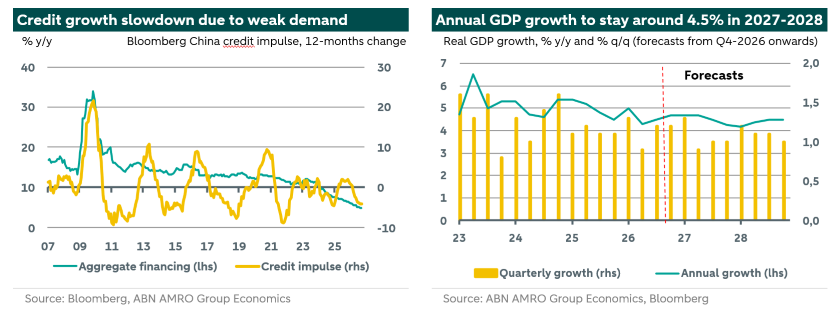
Beijing’s flagship investment project is the Six Networks, a ±CNY 25 trn multiyear infrastructure scheme for six sectors deemed crucial to solidify China’s future high-tech leadership: computers/data/AI, communication, logistics, power grids, underground pipes and water. In nominal terms, these investments would average ±3.5% of 2026 GDP annually in 2026-2030. However, this should be seen against the background of the broader investment slump mentioned above, while these amounts are not ‘new money’. The scheme was already included in China’s previous 5-year plan: the nominal increase compared to the former plan is 35%. Despite this, we still think the Six Networks scheme is a promising initiative, as it 1) gives a stronger role to the central government, which can bypass obstructions faced by local governments (which may become even more cautious in the run-up to the government reshuffle at the 21th CCP Congress in Q4-27, 2) it seems better coordinated and more future-fit than ‘old-school’ infrastructure projects typically chosen to boost short-term growth, and 3) it may well contribute to a bottoming out of credit growth (which undergoes a longstanding slowdown on weak credit demand) and a turnaround in overall investment.
Despite hiccups, we do not expect trade relations with US/EU to spiral out of control
We assume the landslide Blue Wave in the US midterm elections will not lead to large, immediate changes in the US-China trade relationship. The Trump-Xi meeting in September confirmed both superpowers prefer to stick with the fragile equilibrium. The tariff/chokepoint truce has been extended until 1 January 2027, and is likely to be extended further. The US delayed an additional 7.5% overcapacity tariff, but China had indicated it would tolerate that anyway (following earlier tariff reductions). EU-China trade relations are at a critical juncture at the moment, with the EU expanding its trade toolkit to manage China-related challenges/risks. Although the EU is taking a tougher stance, the approach followed is less disruptive than what the US followed last year, with the recent deal on EU hybrid car imports a clear example of a more cooperative approach. Given their mutual economic interests, we do not expect EU-China tensions to escalate into a full-scale trade war (see our thematic Will China Shock 2.0 trigger an EU-China trade war?).
We expect annual GDP growth to remain around 4.5% in 2027 and 2028
All told, in our base case we anticipate more targeted stimulus aimed at stabilising GDP growth, rather than a ‘big bazooka’ sparking a new boom. We assume Beijing will set a growth target for 2027 of ‘around 4.5%’ (to be confirmed in the NPC meeting scheduled for early March). We have tweaked our quarterly growth profile somewhat, anticipating targeted stimulus to filter through in early 2027 in particular. We expect full-year annual growth to drop slightly, from 4.6% in 2026 to 4.5% in 2027 and 4.4% in 2028. The main downside risks to our growth forecasts are related to 1) disappointing targeted support measures, 2) a more severe (re-)escalation of trade tensions with EU and/or US, and 3) other geopolitical events (such as an intensifying conflict around Taiwan). Upside risks would stem from stronger than expected measures to stabilise the real estate sector, boost domestic consumption and investment, or other measures to ease domestic supply-demand imbalances; such rebalancing could also help to soften trade frictions.