Global climate policy after the US withdrawal: Europe braces for a warmer world

After taking office in January 2025, the Trump administration withdrew from the Paris Agreement and began dismantling federal climate policies. The recently published UNEP Emissions Gap Report 2026 (see here) provides an annual assessment of the gap between current climate commitments and the emission reductions needed to meet the goals of the Paris Agreement. This year’s report concludes that an overshoot of 1.5°C is now unavoidable, shifting the focus towards limiting its magnitude and duration and ultimately bringing global warming back to 1.5°C by the end of the century. Against this backdrop, climate adaptation has become increasingly important. In this research note, we examine how GHG emissions have evolved in the US and other major economies since the US withdrawal. We then assess how climate policies and ambitions have changed across major countries and regions, as reflected in their NDCs. Finally, we examine the European Commission’s recently published EU Framework for Climate Resilience, which reflects the growing recognition that Europe needs to prepare for a warmer world even as efforts to curb emissions continue.


Global GHG emissions: US drives the 2025 rise
Global GHG emissions remained almost unchanged between 2024 and 2025, reaching 58.4 GtCO₂e (gigatonnes of carbon dioxide equivalent) in 2025. These emissions include those from LULUCF (Land Use, Land-Use Change and Forestry), which are subject to the highest level of uncertainty. Excluding LULUCF, global emissions increased by 0.7% in 2025 compared with 2024, reaching 54.1 GtCO₂e.
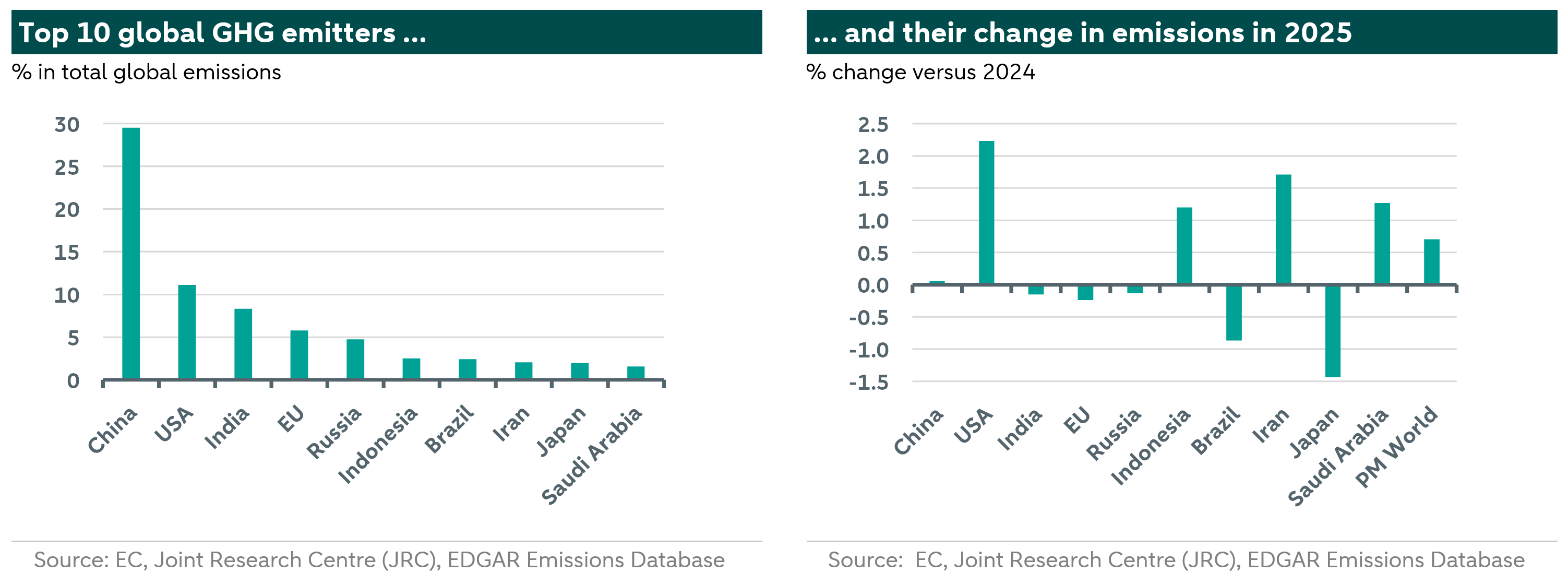
Among the top 10 global emitters, the US recorded the largest increase in emissions in 2025, rising by 2.2% to 6.0 GtCO₂e. The increase was mainly due to higher electricity demand and a rebound in coal-fired power generation. Although China remained by far the world’s largest emitter, accounting for 29.5% of global emissions in 2025, its emissions increased by only 0.1%, the slowest growth since 2015. This slowdown was mainly due to the rapid expansion of solar and wind power, combined with lower emissions from carbon-intensive industries. EU emissions, which accounted for 5.8% of the global total, continued to decline in 2025 (-0.2%), although the pace of decline was the slowest since 2018.
Looking at contributions to the global change in emissions in 2025, the US accounted for the largest share of the increase, contributing 0.24 percentage points to the total 0.7% rise. At the other end of the spectrum, Japan made the largest downward contribution to the global change in GHG emissions (see the two graphs below).
More countries have new NDCs, yet the impact on projected emissions is minimal
While the US withdrew from the Paris Agreement, the rest of the world did not stand still and continued to make progress in efforts to limit global warming. According to the UN’s Emissions Gap Report 2026, the number of new NDCs has more than doubled since last year’s report, while their coverage of global GHG emissions has increased by about 12 percentage points. As of 1 September 2026, 124 Parties (with the EU counted as one) had submitted new NDCs, accounting for about 75 per cent of global emissions, compared with 57 submissions covering 63 per cent of emissions a year earlier. Overall, 167 Parties, accounting for about 83 per cent of global emissions, now have an active NDC.
Despite the rise in the number of new NDCs, their additional impact on projected emissions compared with last year’s assessment is limited, ranging from +0.4 GtCO₂e for unconditional NDCs to -0.3 GtCO₂e for conditional NDCs (climate commitments that countries make conditional on receiving international support, such as finance, technology transfer or capacity-building) by 2035. This is partly because last year’s assessment made overly optimistic assumptions about emissions in countries that had not yet submitted a new NDC and where emissions continue to rise, such as India. This has largely offset the additional emissions reductions from new NDCs submitted by other countries since last year, including Indonesia, Mexico and the Republic of Korea.
Besides the near-zero impact of the new NDCs on global emissions, a significant implementation gap remains. The implementation gap is defined as the difference between emissions projected under current policies and those consistent with the full implementation of NDC targets. For 2030, emissions under current policies are estimated to be about 2 GtCO₂e (around 3.5%) above the level implied by unconditional NDCs and about 4 GtCO₂e (around 7%) above the level implied by conditional NDCs. For 2035, the implementation gaps widen to approximately 3 GtCO₂e (around 6%) and 6 GtCO₂e (around 12%), respectively. Compared with last year’s assessment, there has been very little improvement in the implementation gap. In other words, countries are not only insufficiently ambitious in their pledges; many also lack the policies needed to meet the pledges they have already made.
Global emissions gap remains wide
One of the main messages of the Global Emissions Gap Report 2026 is that decades of insufficient climate action have made exceedance of the 1.5°C global warming limit unavoidable. Consequently, the UN has calculated new emissions gaps, defined as the difference between estimated global GHG emissions resulting from the full implementation of the latest NDCs and the emission levels required under updated mitigation pathways to cost-effectively limit global warming to specific levels.
One of these new pathways is the ‘lowest 1.5°C overshoot’ scenario. It aims to keep global warming well below 2°C, minimize the duration and magnitude of the overshoot above 1.5°C, and establish a credible pathway back to 1.5°C by 2100. Another is an updated ‘below 2°C’ pathway. The figure below shows global emissions under various scenarios, including the ‘lowest 1.5°C overshoot’ scenario’, the ‘below 2°C’ scenario, and the current-policies scenario.
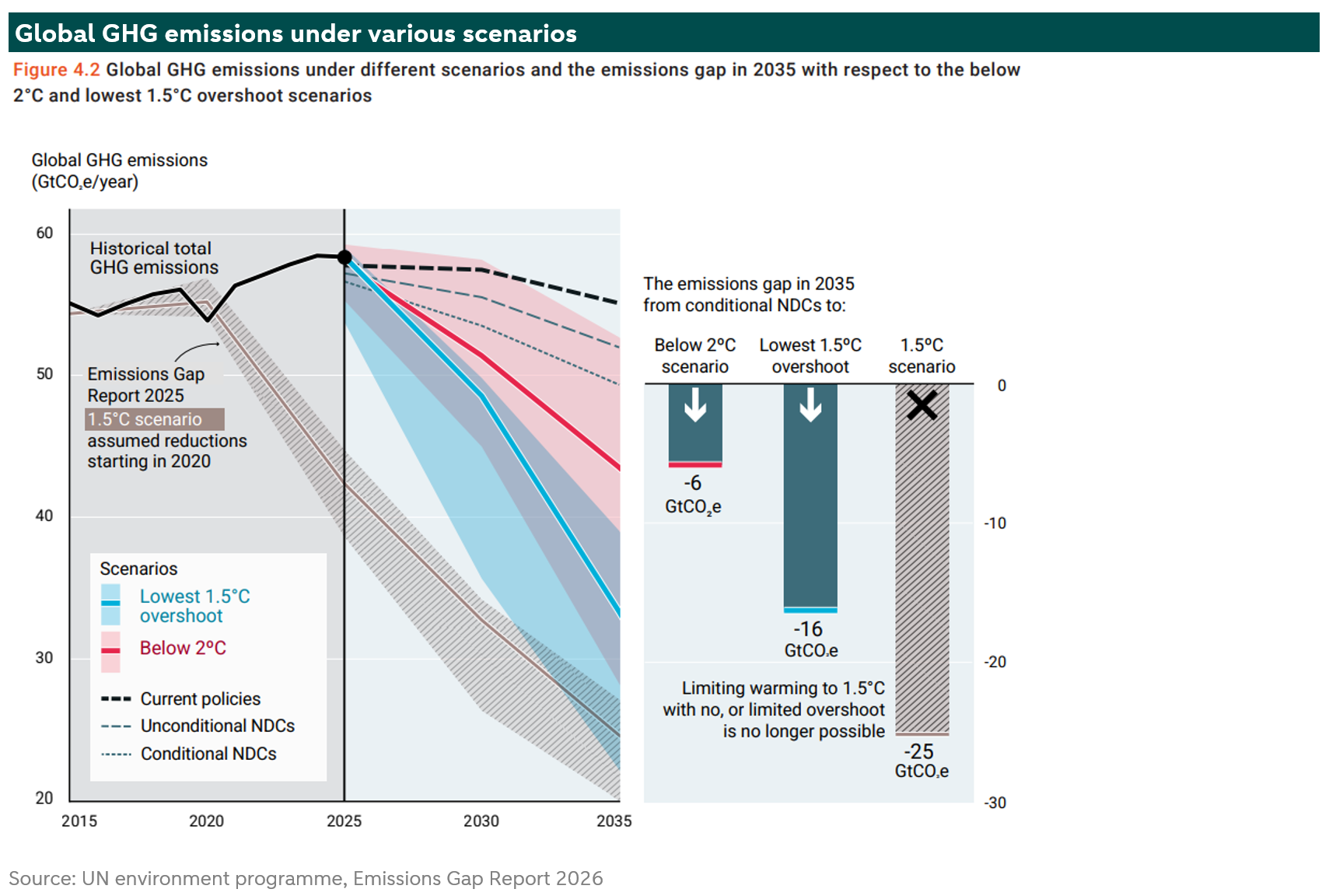
This figure illustrates that the latest NDCs are only sufficient to reduce emissions by around 11–15% by 2035 compared with 2025 levels. This compares with a required 45% reduction over the same period under the ‘lowest 1.5°C overshoot’ scenario and an estimated 6% reduction under current policies.
Full implementation of conditional and unconditional NDCs is estimated to result in an emissions gap of 6 GtCO₂e in 2035 relative to the ‘below 2°C’ pathway’ and 16 GtCO₂e relative to the ‘lowest 1.5°C overshoot’ pathway. These gaps are 2–3 GtCO₂e larger if only unconditional NDCs are implemented. If only current policies are followed and the NDCs are not achieved, the gaps widen further, to 12 GtCO₂e for the ‘below 2°C’ pathway and 22 GtCO₂e (equal to around 40% of 2025 emissions) for the ‘lowest 1.5°C overshoot’ pathway.
Estimates for global warming higher
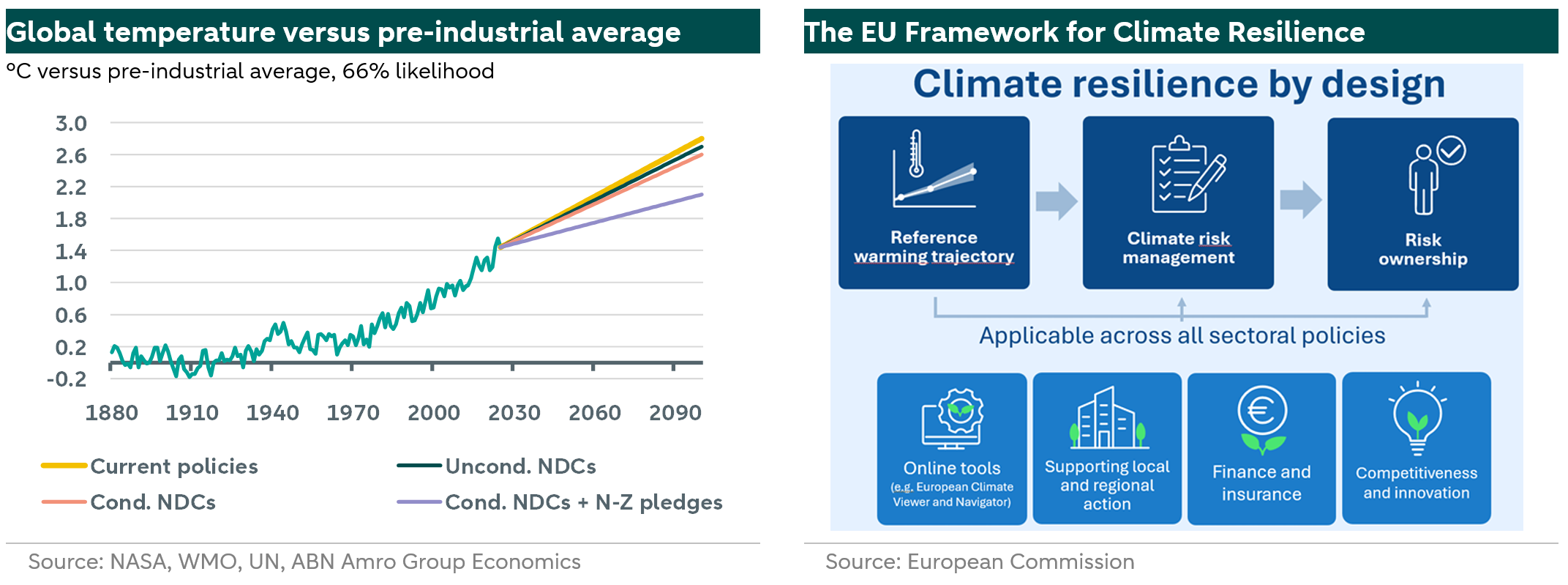
The adjusted emissions pathways also affect estimates of global warming by the end of this century. If current policies continue, global warming is projected to reach about 2.8°C by 2100 (range: 2.2–3.8°C), with a 66% likelihood. If unconditional NDCs are fully implemented by 2035 and similar mitigation efforts continue thereafter, warming could be limited to around 2.7°C (range: 2.0–3.4°C) by 2100 (also 66% likelihood). Full implementation of conditional NDCs could further reduce warming to around 2.6°C (range: 1.9–3.3°C), with a 66% likelihood. In the most optimistic scenario, in which all NDCs are met, and all net-zero pledges are fulfilled, there is a 66% likelihood that global warming will be limited to 2.1°C this century.
Compared with last year’s report, projected warming under the NDC scenarios is now around 0.2–0.3°C higher. This increase reflects updated estimates showing that emissions in 2035 are 3–4 GtCO₂e higher than previously projected. About half of the increase in projected warming is due to the US abandoning its NDC, while the other half results from higher estimates of historical emissions. By contrast, new NDCs submitted since last year have had almost no impact on projected emissions or warming.
The EC presents a Climate Resilience Framework
Against the backdrop of higher projected global warming, the European Commission has presented a new Climate Resilience Framework (see ) aimed at better preparing Europe for the physical consequences of climate change. The Framework does not replace efforts to reduce emissions. Rather, it recognises that even with further mitigation, higher temperatures will increase Europe's exposure to heatwaves, droughts, floods, wildfires and other climate-related hazards. The economic relevance is already visible: climate-related damages in Europe, according to the Framework, amounted to around EUR 200bn over 2022-2025, equivalent to more than 0.3% of annual GDP on average. Meanwhile, the Commission estimates that adapting Europe's infrastructure and economy to future climate conditions will require investment of around EUR 70bn annually, equal to almost 0.4% of EU 2025 GDP.
The estimated EUR 70bn annual adaptation need is not solely a public-sector bill, but encompasses investment by the EU, Member States and the private sector. While public authorities are likely to remain central, particularly for infrastructure and other public goods, constrained fiscal space means that mobilising private capital will also be important. Indeed, the Commission sees a role for private investment and blended finance in scaling up resilience investment. This could increasingly turn climate adaptation into an investable theme, particularly as spending on resilient infrastructure, buildings and other adaptation solutions rises.
The European Investment Bank (EIB) will provide at least EUR 30 bn in climate adaptation financing between 2026 and 2030, twice the volume delivered in 2021-2025. However, this commitment has a broader geographical scope than the EU. According to the EU Framework for Climate Resilience, the financing will support climate-resilient investments and adaptation technologies and solutions “in Europe and globally.” The EUR 30 billion should therefore not be viewed as an EU-specific contribution to Europe’s estimated adaptation investment needs of around EUR 70bn annually. The framework does not specify how much of the EIB envelope will ultimately be allocated within the EU versus elsewhere.
At the heart of the Framework is a shift from reacting to climate-related disasters to anticipating and managing climate risks before they materialise. The proposed European Climate Resilience Law would establish a common reference trajectory for global warming to inform climate-risk assessments and long-term decisions. In practice, this means that decisions on infrastructure and other long-lived assets should increasingly account for the climate conditions expected over their lifetime, rather than relying predominantly on historical conditions. The Law would clarify responsibility for managing climate risks by identifying policy risk owners across sectors and levels of government. It would consolidate Member States’ existing planning obligations into a single national climate resilience plan. It would also introduce more systematic and comparable monitoring of resilience outcomes at national and EU level.
For companies and investors, this implies both costs and opportunities. More stringent resilience requirements and greater exposure to physical climate risks could increase adaptation and insurance costs and affect the value of vulnerable assets. At the same time, rising investment in resilient infrastructure, buildings, water systems and other adaptation measures should generate additional demand for climate-resilience solutions. The Commission cites estimates that the global market for such solutions could reach around EUR 3.5tn by 2050 (see ), highlighting the commercial opportunity alongside the risks.