China - Beijing to keep targeted approach amid record trade surplus

Mixed macro data as China enters the Year of the (Fire) Horse. Domestic supply-demand imbalances culminate in record trade surpluses. Policy targets to be announced in early March; China to benefit from US Supreme Court ruling.

Mixed macro data as China enters the Year of the (Fire) Horse
As usual, due to the Lunar New Year (LNY) break (held mid-February this year), some data for January/February are combined and published mid-March. Recent data that were still published are a mixed bag. January PMIs came in weaker than expected, and brought a renewed divergence between the official PMIs and RatingDog’s alternative ones. The official composite PMI fell below the neutral mark again (49.8), after a sudden improvement in December, while RatingDog’s composite PMI rose to a three-month high of 51.6. Overall lending data for January came in stronger than expected, but this was driven by the issuance of government bonds. New bank loans disappointed, with household and corporate loan demand still weak on fragile confidence. On the positive side, the first data on consumption and mobility data covering the LNY holiday were quite solid, partly reflecting better weather conditions compared to 2025.
Domestic supply-demand imbalances culminate in record trade surpluses
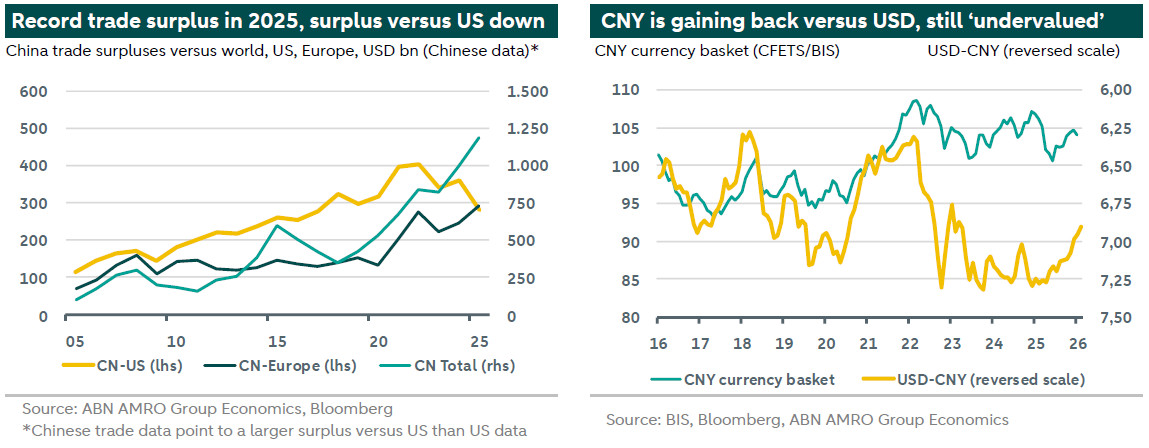
On the inflation front, after rising to a 3-year high of 0.8% y/y in December, CPI inflation fell to 0.2% y/y in January. This was driven by base effects; we expect CPI inflation to average 0.9% y/y this year, up from 0.1% in 2025, but to remain low. The easing of producer price deflation also has further to run. The fading of deflationary pressures is not reflecting easing domestic supply-demand, though. China’s growth is still led by the supply side, with exports and industrial production holding up, while the demand side is suffering from the ongoing property downturn and weak confidence. This imbalance goes hand in hand with rising external surpluses (see chart), potentially feeding trade tensions. recently advised Beijing again to put more efforts into shifting towards a consumption-led growth model and allow more exchange rate flexibility, as the current model creates negative spillovers to trading partners.
Policy targets to be announced early March; China benefits from Supreme Court ruling
In early March, Beijing’s 2026 policy targets and the 2026-30 5-year plan will be presented to parliament (NPC). The 2026 growth target will likely be set at ‘a range of 4.5-5.0%’ or ‘around 5.0%’. Despite the IMF advise, we think Beijing is not in a hurry to radically step up macro support, as solid exports – amidst a firming global business cycle – keep safeguarding growth, and the US truce brought external stability. Beijing keeps rolling out consumption support (eg. extending subsidies for durable goods and consumer loans, income transfers via pensions, childcare), but the support stance remains ‘targeted’. On the FX front, we expect Beijing to tolerate more CNY strengthening versus USD, while keeping the yuan more stable versus a broad currency basket to safeguard competitiveness. Regarding US relations, China is set to benefit from the US Supreme Court Ruling and the replacement of IEEPA by Section 212 tariffs (see here), while Beijing’s hand looks strengthened in the run-up to a potential Trump-Xi meeting end March/early April. Still, we think both China and the US have their own reasons to keep this trade truce broadly in tact, partly because it also deals with the thorny issue of chokepoint restrictions (rare earths, semiconductors).