Global Monthly - Geopolitics bad, macro good
While the risks have certainly not gone away, economic data has been generally firming, while near term positive impulses are getting stronger. Higher AI capex spending looks to be bigger than expected, fiscal stimulus is ramping up and financial conditions remain easy. So far geopolitics has been the dog, which barks very loudly, but does not bite. That cannot be taken for granted with Iran the latest flashpoint. SCOTUS decision to scrap IEEPA tariffs may not change too much, not least because fresh tariffs have largely replaced the old ones. There is an increasing chance that the global economy may run hot in the near term but also of a future hangover further down the line.


Global View: Positive drivers have been building despite all the risks
In our 2026 outlook we struck a constructive tone for the outlook despite what appeared to be a wall of worries, from the changing world order to fiscal vulnerabilities, from concerns about tech bubbles to fears about the Fed’s independence. However, our view was that many of these risks seemed to be either not imminent or not tangible enough to be part of a base case. At the same time the classic drivers of cyclical recoveries were coming together with a powerful boost from AI and this had the potential to sustain the expansion. Some months on, while the risks have certainly not gone away, economic data has been generally firming, while the near term positive impulses if anything are getting stronger. There is even a building chance that the global economy will start to run hot. So far geopolitics has been the dog, which barks very loudly, but does not bite.
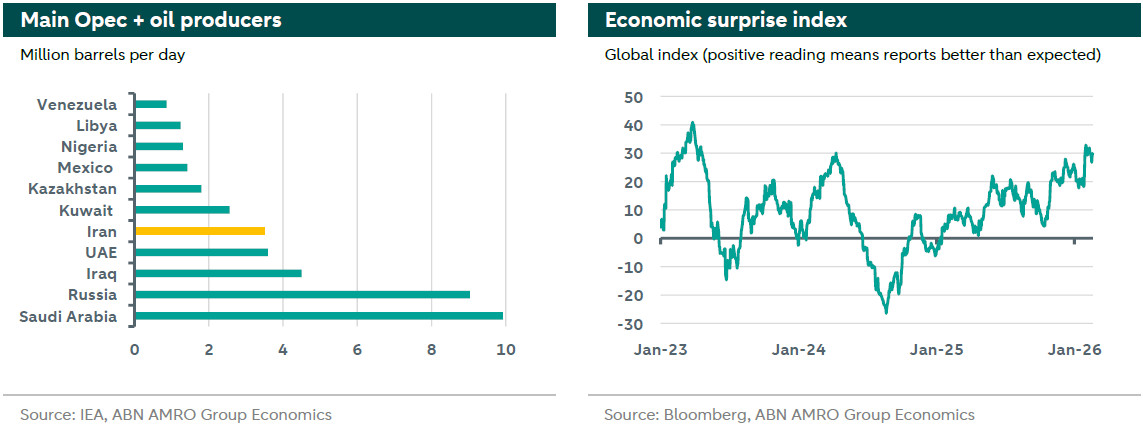
At the time of writing, the latest flashpoint concerns a potential US military attack on Iran. The way this could impact the economic outlook is via its potential to drive up oil prices, and indeed a risk premium is already building that has pushed up benchmark levels by around USD 5 per barrel, despite what looks to be a building supply glut. After all, Iran is a significant oil producer and the strait of Hormuz - between Iran and Oman - is probably the world's most strategically important energy choke point. It is difficult to know how this will play out. We could wake up either to the ‘greatest deal in history’ or to military conflict that threatens energy supply. One would not surprise more than the other. And indeed there is a danger now of treating geopolitics like the ‘boy who cried wolf’. However, so far at least, while the geopolitics has been bad, the macro has been good.
Data have been improving
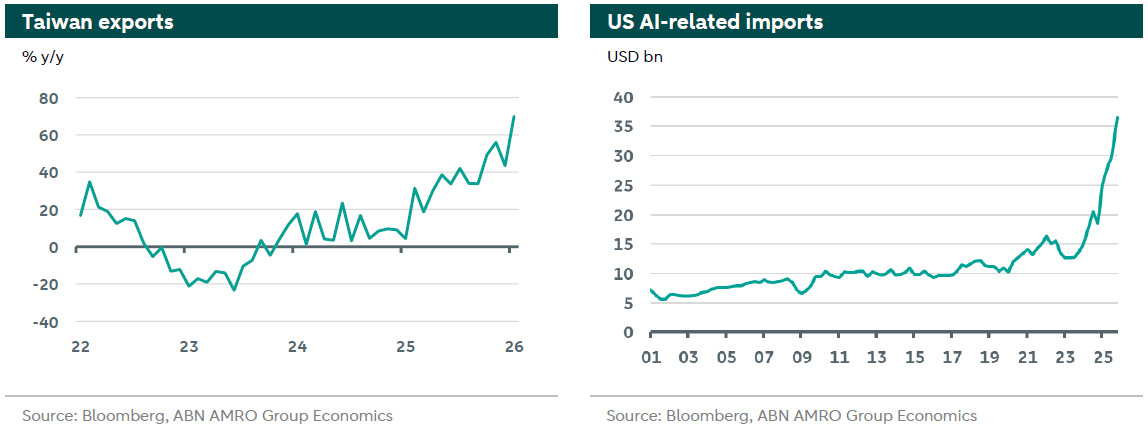
Let’s start with the data. Economic data releases have been better than expected (see chart above on the right), and not just because of low expectations. Domestic demand has remained robust, but perhaps most encouragingly is that manufacturing, a previous weak spot, appears to be gaining traction (also see our note here). The PMI surveys have been on a rising trend, while the hard data for factory orders in the US and Germany has also been strong. All this despite the impact of US tariffs. Part of this is explained by effective tariff rates being much lower than headline announcements, while at the same time the AI boom appears to be having a strong impact on global trade. For instance, US AI-related imports are up by an extraordinary 166% y/y. Taiwan’s exports have been surging over recent months, even though the latest reading might be inflated by a change in the timing of the lunar new year. The Fed estimated in a note last year that Taiwan’s AI-related exports account for around 13% of its GDP (see ).
Positive drivers are building
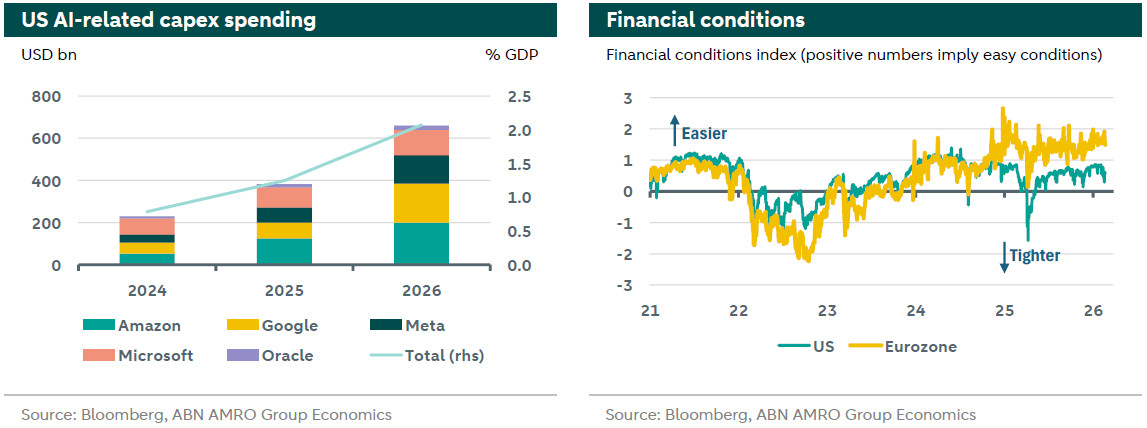
The announcements of the large US tech companies of AI-related capex were much larger than expected. The capex plans of just five of the large tech companies amount to around 2% of US GDP up from 1.2% last year. There has been some softening of equity markets on the back of this as investors are concerned that these incredible capital expenditures are outpacing the earnings potential of the new technology (more about this later). In addition, investors are assessing the winners and losers from AI. For instance, AI group Anthropic (which is a private company) has recently released marketing, legal and finance additions to its Claude Co-work tool, which has hit software stocks hard reflecting concerns about the implications for their business models. Despite recent equity market weakness, however, financial conditions remain accommodative and will continue to provide support for the economy.
Supreme Court ruling to scrap IEEPA tariffs may not mean much
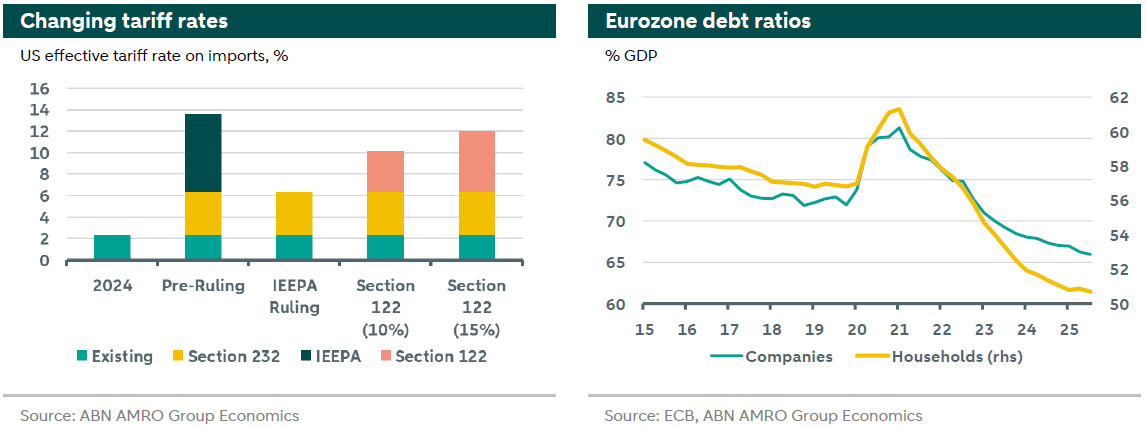
The ruling of the Supreme Court of the United States that President Trump’s tariffs under the International Emergency Economic Powers Act (IEEPA) were illegal could on the surface be seen as an additional positive driver. However, this is too optimistic a take. The Trump administration has imposed a 10% tariff on US imports under Section 122 of the Trade Act for a period of 150 days (with important sector exemptions) and has suggested this will go up to 15%. This will provide some offset to the fall in tariffs due to the scrapping of the IEEPA variants, while additional tariffs are being considered under other laws. Indeed, the effective tariff rate may end up only slightly below the one that stood before the ruling. Beyond this, there are distributional elements, with emerging markets in particular benefiting from lower tariffs (see our note here).
Possibility of running hot
The chances are rising of a stronger acceleration in economic growth than under our base case. The AI boost aside, there is also the prospect of more fiscal stimulus globally. We are seeing increasingly convincing signs that European defence spending and production is ramping up, especially in Germany. The ‘Greenland episode’ if anything would add to the sense of urgency. Meanwhile, Japan’s Prime Minister Sanae Takaichi was recently re-elected with a landslide gave her an impregnable majority in the country’s lower house of parliament, which gives her every opportunity (the bond market aside – more on this later) to carry out her sizeable spending and tax cut pledges. Furthermore, the US authorities might also be tempted to put in place additional stimulus before the Midterms, particularly in the form of cheques to lower and middle-income households.
Meanwhile, private sector balance sheets in advanced economies are in good shape and provide scope for a pickup in domestic demand. This is particularly the case in the eurozone, where savings rates have remained elevated, while debt ratios have collapsed (see chart above on the right). The return of ‘animal spirits’, particularly in Europe, could therefore provide some additional upside. Finally, usually a sharper acceleration in economic growth is offset by central banks taking away the punch bowl. As we discuss below in our Spotlight, a Warsh Fed may actually continue to cut rates. In Japan, Prime Minister Takaichi is reportedly putting pressure on the BoJ to be very careful with additional rate hikes.
Sowing the seeds for a future hangover
Today’s positive drivers may prove to be tomorrow’s negative drivers. AI will likely lead to a significant acceleration in productivity growth. However, our calculations suggest that productivity gains would need to come in at the very upper end of estimates and come through relatively quickly for the capital spending to make economic sense. While the ongoing ramp up in AI capex is a positive for economic growth in the short-term, an eventual slowdown or worse implies medium-to-long term risks. Especially if coupled with a tech-driven market correction that tightened financial conditions. A second risk relates to the deterioration in fiscal fundamentals in a number of countries, including the US, Japan and France, which could lead to a sharper rise in term premia. A final risk, that could exacerbate the other two risks is a potential eventual reversal in US monetary policy, as inflation may remain sticky despite the AI productivity boost, which could also have the impact of raising neutral interest rates.