Housing market monitor - Will 2026 be an unexceptional year?

We expect house prices to rise 3% in 2026 and 4% in 2027. Income growth and low supply outweigh slightly rising mortgage rates. The number of housing transactions decreases 1% in 2026 and decreases 4% in 2027 due to less sales of investment properties.

Mike Langen
Senior Economist Housing Market
The Dutch housing market surprised with strong growth in 2025.
With only December data missing, we expect that house prices have risen by about 8.6% in 2025. Therewith, the price increase in 2025 is almost as high as in 2024 (8.7%). We see a similar picture for the number of transactions: we expect an increase of about 16% or a total of about 239,000 transactions in 2025. If this realizes, it would be the highest number of transactions in the past 10 years (current record year is 2020 with 235,511 transactions). The main causes of the price increase were the relatively low interest rates, stable household income growth and the continuing housing shortage. In addition, the sale of rental properties by investors caused a temporary increase in the number of transactions.
For 2026, we expect house prices to rise 3% and for 2027 we expect a 4% increase.
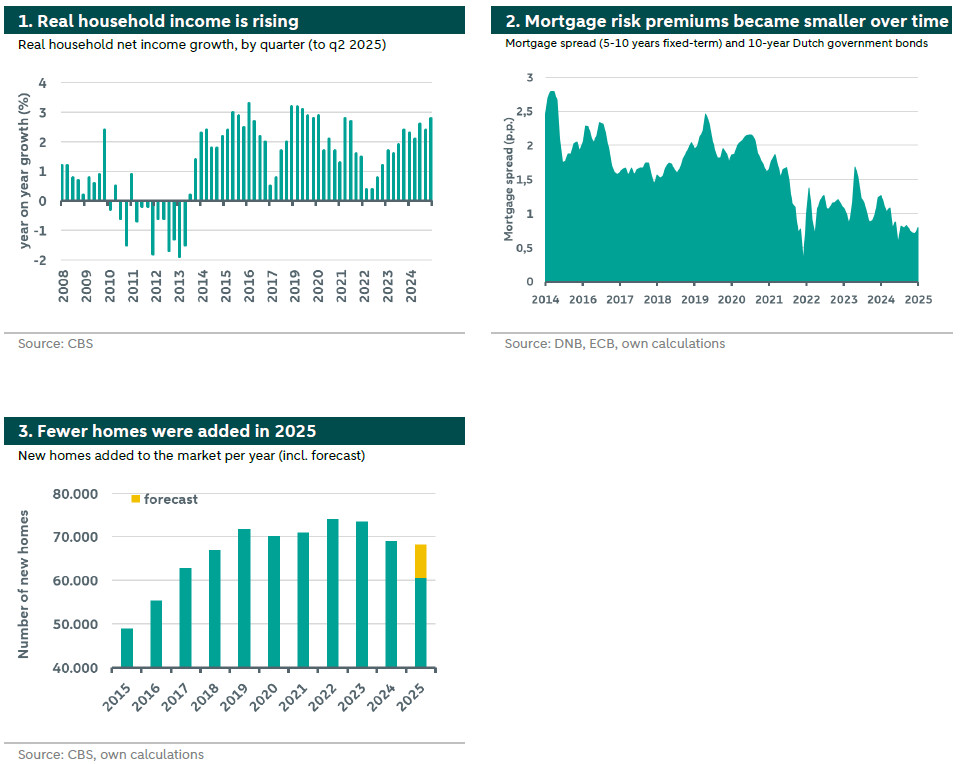
Macroeconomic conditions in the Netherlands are good, despite the uncertainty surrounding import tariffs and global trade. We expect the Dutch economy to grow by 1.2% in 2026 and 1.4% in 2027, slightly above the EU average. At the same time, we expect Dutch inflation, currently still above the eurozone average at 3%, to fall to 2.4% in 2026 and 2.5% in 2027. This has implications for the Dutch housing market, as the economic situation and the cost of living are important factors for income growth adjusted for inflation. With increasing real household income, households can spend more money on housing and demand for housing increases. In our macroeconomic projections, we assume that real household income will continue to grow over the next two years. Figure 1 shows the growth of real net household income on a quarterly basis, indicating that incomes are rising at an increasingly pace. This leads to the conclusion that the demand for housing remains strong and upward pressure on housing prices continues.
Interest rates point to higher financing costs in the future.
Mortgage rates are another important factor that affect housing demand. For most of 2025, mortgage rates were relatively constant. For example, mortgage rates for an interest fixed term of 5 to 10 years around 3.5% since January 2025. However, at the end of 2025, most banks announced slight increases in mortgage interest rates. This increase followed the rise in interest rates of long-term government bonds, which are an important benchmark for mortgage interest rates with similar maturities. Interest rates on Dutch government bonds recently, among other, due to higher sovereign debt in the euro zone, which raises credit risks and increases government interest rates. Up to a certain point, mortgage lenders can absorb some of the increases of government interest rates by accepting a lower interest margin. In Figure 2, we see that the gap between mortgage rates and government bond rates with similar interest periods narrowed in the past. As a result, these days lenders have little room left to absorb further increases in government bond yields. With many euro countries planning to take on more debt, we expect long-term government bond yields to rise further over the next two years. This will then lead to higher mortgage rates, which will increase financing cost and therefore decrease housing demand.
The supply shortage points to further price increases.
After talking about the demand factors, it’s important to consider housing supply. Figure 3 shows the number of new homes added to the market, including our forecast for December 2025 for which data are not yet available. In line with the government's estimate, we expect to see a decrease in newly added homes in 2025. The supply of new homes shows a downward trend since 2023, despite the ambition of the government to build 100,000 homes per year. As a result, the housing shortage increases. The causes of the lack of new construction can be broadly divided into two categories. On the one hand, there are practical bottlenecks, such as lack of construction workers / technicians, lengthy planning processes, grid congestion and nitrogen constraints. On the other hand, many investors do not see the financial viability of projects because of rent caps, unsatisfactory tax regulations and high land prices. On a silver lining, we see the construction pipeline growing, indicating that housing supply could increase in the coming years.[1] However, new housing projects takes on average 8-12 years from planning to delivery, and the housing shortage needs to be reduced first. Therefore, we do not expect supply to lead to lower prices over the next two years.
We expect housing transactions to fall 1% in 2026 and 4% in 2027.
The lack of new construction also negatively affects the number of housing transactions. There are fewer homes to move, which means fewer transactions. On top of this, the sale of rental properties by private investors will contribute less to the growth of housing transactions. These sales caused a sharp increase in the number of transactions in 2025. Many of the sold units were apartments, on average smaller and more often requiring renovation. As a result, they were also often cheaper. In the third quarter, buyers paid on average euros less for an apartment from an investor than for one from another owner. In 2026, we expect the sale of rental properties to continue in the first half of the year. This is because apartments tend to sell better when they are vacant and we expect some investors to wait until temporary lease contracts expire. However, we think the number of transactions attributed to these sales will be less than in 2025. Therefore, we expect the total number of transactions in 2026 to still be high, but 1% less than in 2025. In 2027, we expect the abnormal sales of rental properties to disappear, leading to a 4% decrease in the number of transactions. This does not contradict our price estimates. In the past we have often seen years where transactions and prices went in different directions.
There are ambitious plans from the government, but their implementation will take time.
In the future, new imput for the housing market could come from the new government. At the time of writing, a new coalition has not yet been formed, but D66 and CDA are taking the lead in forming one. If we look at their for the housing market, we see big plans but few specific details. The main focus seems to be on increasing the housing supply, but a strategy to evaluate is missing, apart from the ambition to invest more. We assume this is partly a strategic choice to keep options open for coalition building. However, this makes it difficult to estimate what the possible effects on the housing market might be. Although the aforementioned parties are also in favour of abolishing the mortgage interest deduction (HRA), their view on this subject is less pronounced than during the election campaign. In the vision, they set the condition that homeowners should not be disadvantaged by the abolition of the HRA. They demand possible income tax relief (using the saved subsidies) and that such a compensating mechanism should first be worked out. However, this is more complex and requires more time to implement. Also it suggests at more gentle approach, suggesting that the abolishment of the HRA will not reduce nominal house prices too much. Since we do not think that a new policy around the HRA will come in place in the next two years, we have not included any effect in our forecasts.
The EU plans to tackle affordable housing in the coming years.
Having recognized that there is a housing crisis in Europe, the EU recently its new plan for more affordable housing. Overall, the EU aims to increase housing supply by reducing restrictions, equalizing rules between member states and providing more financing options. Many aspects of the plan are not really worked out yet, but the idea is to introduce a new law and a package of measures in 2026 and 2027. What can already be said is that the EU wants to encourage more cross-border construction activities, which are currently limited by national building regulations. Furthermore, the EU wants to simplify building regulations, making processes more efficient and possibly cheaper. In addition, national governments get more freedom to finance affordable housing by lifting previous support limits. For the Netherlands, this means that the middle rental segment can be supported with more subsidies, for example by expanding the activities of the housing corporations into this segment. This can make it more financially attractive for developers and eventually increasing supply. Another focus of the plan is to establish EU-wide regulations for short-term rentals, such as Airbnb. However, since most major cities in the Netherlands already have local regulations, we expect this to have less impact on the Netherlands. Overall, the plan could provide interesting incentives for housing supply in the coming years. At this early stage, however, we do not think the proposed measures will affect prices in 2026 and 2027 and consequently we have not included them in our forecast.