Spotlight - The Warsh Fed in 2026
In the near-term, Warsh’s ‘conviction-based’ policy drive puts downward pressure on rates. Despite a bullish outlook on the US economy and increasing inflation, we see 75 bps of cuts this year. This view is grounded in a more dovish Fed reaction function that downplays recent data.

At the end of last month, Kevin Warsh was nominated to be the next Fed chair. While a lot is still unknown about how he’ll try to influence Fed policy, three points stand out from his most recent remarks about the Fed. The first is his unease with Quantitative Easing. We’ve written extensively about how that might ultimately affect policy (spoiler: higher long-term rates) but this will likely be a long and gradual process. In the nearer term, we should probably expect less transparency, with less communication and guidance from FOMC officials. Most important for the near term, however, is his idea of ‘conviction-based’ policy. Warsh has been quite clear on what his current conviction for the US economy is. He has pushed a bullish outlook on the back of AI productivity gains and pro-growth policies from the Trump administration. He believes that through AI, the US can keep on growing at the current strong pace, with limited inflation risk. This offers room for lower rates in the near term.
How much credibility is there to the AI story? It seems likely that in the long run, AI becomes a general-purpose technology, similar to electricity or computers, which should boost productivity, raising potential growth. Then indeed, the economy can grow faster without generating inflationary pressure. The big question is whether the US is already in that ‘long run’ state that would allow for 3%+ annual growth without inciting inflationary pressure, especially in the absence of labour force growth. Some of the recent data may be interpreted that way. The decoupling between economic growth and jobs growth we described last month has only intensified after the revision to NFP published this month (see also US chapter). Beyond an AI productivity boost, it could be labour scarcity pushing firms to extract more outper per worker, or tariffs and a weaker dollar may have boosted competitiveness leading to increased capacity utilization. There’s little direct empirical evidence for any of these theories, including the AI productivity one. Still, we saw exceptionally strong growth in the second half of last year, with limited demand-driven inflation pressure.
We share the bullish outlook for the US economy, with higher growth forecasts than consensus, supported by fiscal and monetary easing, as well as large private sector investment stemming from the tech sector. We differ in our view on whether this will lead to increased price pressure, leading to our above consensus inflation call. Despite that, we do still see more rate cuts than current market pricing would suggest. While that may seem inconsistent, the answer lies in a more dovish reaction function of the Fed which has gradually revealed itself over the past half year, where inflation above target carries significantly less weight than any potential threats to employment.
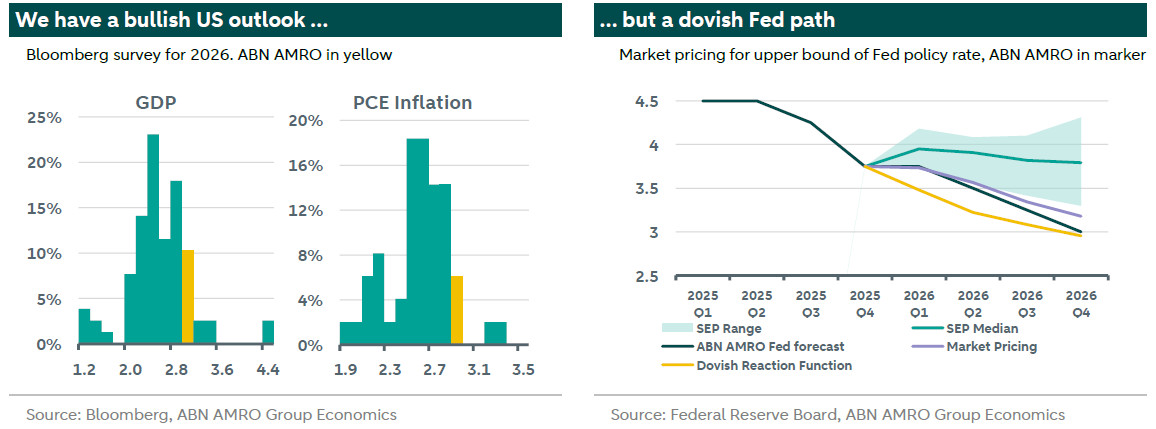
Usually, such strong growth would, in conjunction with above target inflation, quite simply imply at the very least a hold, if not a rate hike. Still, a not insignificant subset of the FOMC is sure to continue supporting rate cuts until at least 3%. Beyond those members, the FOMC has shown itself to be quite open to ease despite elevated inflation. It continues to interpret the current level in the most benign of ways; stating that at least inflation is not accelerating, or that most of the overshoot can be attributed to one-off tariff shocks. ‘On track’ towards 2% appears to be the bar for the median voter. We’ve previously written about the fact that the Fed’s easing over the past one and a half years seems inconsistent with historical reaction functions, given their Economic Outlook. The chart above suggests that that historical reaction function implies a hike for all but the most dovish forecasts in the current Summary of Economic Projections. A recalibration of the reaction function that matches the recent Fed path with SEP projections provides a more Dovish Reaction Function (in yellow), even without a Warsh effect. With the current median SEP forecast, there is room to continue easing at 25 bps pace. Our base case of stronger inflation prevents this continued easing in the near term, but the implied policy rate converges to an upper bound of the Federal Funds Rate at 3.00% by year end.