Key views Global Monthly February 2026
The transition from one world order to another is in full swing, but it is still unclear how that new world order will look. The advent of AI, China’s rise, and the US’s relative decline offer challenges but also opportunities. US import tariffs remain a dampener on global trade, despite the recent US Supreme Court ruling. Still, global growth has been resilient given the headwinds. Our base case sees that resilience continuing, albeit with considerable risks. Growth in the US is expected to stay solid, but this masks variation and vulnerability below the surface. Eurozone growth is expected to pick up on higher German fiscal spending, while China may take modest measures to lift demand while keeping its manufacturing growth model intact. Inflation in the US is expected to pick up, but to stay broadly benign in the eurozone. Despite this, the divergence in Fed & ECB rates is expected to narrow significantly, with the ECB expected to keep rates on hold, and the Fed looking through the US inflation overshoot and prioritising the labour market by continuing to cut rates.

Macro
Eurozone
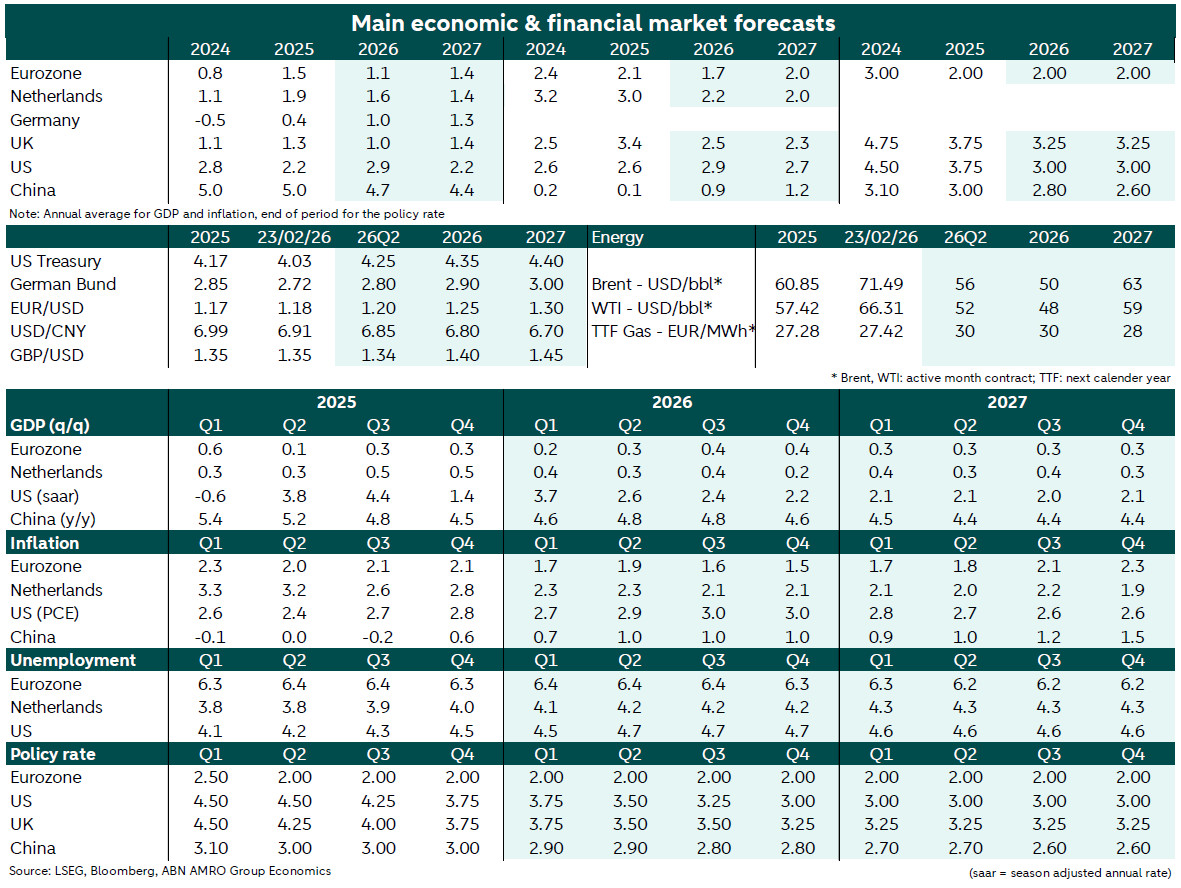
The domestic economy continues to gradually recover, helped by strengthening consumption and resilience in industry, despite the headwinds from US tariffs. This year, higher defence and German infrastructure spending are likely to drive higher quarterly growth. Aggregate inflation remains well behaved, but some key countries are seeing a persistent undershoot of the 2% target. Falling energy prices are likely to drive an undershoot of the 2% inflation target later this year, helped by a stronger euro. However, core inflation is expected to hold steady around the ECB’s target.
The Netherlands
The Dutch economy has shown resilience in 2025. This momentum carries over to 2026 and lead to an upward adjustment of our forecasts to 1.6% in 2026 and 1.4% in 2027. Private consumption and government spending remain the drivers of the outlook. While the geopolitical situation and uncertainty keep a lid on export growth and investment. Inflation (CPI) is expected to ease, further slowly throughout the year to average 2.3% in 2026 down from 3.3% in 2025. The incoming minority coalition presented it’s coalition agreement, however execution is uncertain as it hinges on opposition buy-in
UK
Economic data is sending mixed signals, with the labour market clearly deteriorating, but consumption and business confidence improving. Our base case sees growth gradually picking up over the coming year, helped by reduced fiscal uncertainty and reduced caution among households. Inflation meanwhile is expected to continue normalising, but its flirtation with the BoE’s 2% target is likely to prove short-lived. Sustained 2% inflation will require wage growth to continue to fall significantly, and for inflation expectations to move lower again.
US
The impact of tariff and immigration policy continues to gradually build in the data. The negative impact in the headline figures is overshadowed by the positive impulse from AI investments and monetary and fiscal easing. The first quarter of 2026 will see a reversal from the Q4 shutdown drag, and we expect continued solid growth throughout 2026. After a cooldown in the beginning of the year, inflation rises again due to the final pass-through of tariffs, and demand effects from stimulus. Unemployment continues a gradual, but not dramatic increase, as supply and demand remain mostly in balance.
China
January data (PMIs, lending, inflation) are a mixed bag, while consumption/mobility data covering mid February's Lunar New Year break look solid. Meanwhile, ongoing domestic supply-demand imbalances culminated in a record trade surplus, also with Europe, but the surplus with the US has fallen sharply. China stands to benefit from the US Supreme Court ruling, although we expect both China and the US to broadly stick to their trade truce (in the run-up to a potential Trump-Xi meeting). We expect Beijing to keep policy support targeted, with plans being presented to parliament in early March.
Central Banks & Markets
ECB
The Governing Council kept policy on hold in February, and is likely to remain on hold for the foreseeable future. President Lagarde has reiterated that the ECB is ‘well positioned’, and appears as yet unconcerned by the euro’s recent appreciation. Despite the expected undershoot of the 2% inflation target, the GC seems minded to look through this on the expectation that inflation will return to target in 2027. Near term risks are still tilted to another cut given the looming inflation undershoot, but in 2027, those risks could tilt back towards a hike, with upside risks likely to build from higher German fiscal spending.
Fed
The Fed cut rates in the last three meetings of 2025 but will likely again enter another pause in the first part of this year. Due to stronger growth and demand, waning pressure from the labour market, and continued above-target inflation, we think the Fed will keep on hold until the June meeting, the first meeting with the new chair. From that point onward, a dovish tilt in the reaction function implies it will resume easing once a quarter in response to a gradually slowing economy, despite still elevated inflation. We expect the policy rate to reach 2.75-3.00% by the end of the year, the lower end of neutral estimates.
Bank of England
The MPC kept Bank Rate at 3.75% in February, in line with our expectations. The BoE is now nearing the end of its rate cut cycle, with limited room for further easing given stubborn underlying inflation. Our base case sees two final rate cuts, in Q2 and Q4. Still, the recent easing in wage growth raises the risk of these cuts being frontloaded to the first half of 2026. Injecting considerable uncertainty is the high degree of division on the MPC, with doves and hawks still split finely down the middle. Volatile UK data contributes to this uncertainty.
Bond yields
Both in the US and Europe, 10-year yields have fallen as a result of increased uncertainty in equity markets and lower long-term inflation expectations in both regions in February. Short-term rates have not changed significantly because the interest rate expectations of both the ECB and the Fed have remained largely unchanged, resulting in a flattening of the curve between these maturities. Despite this flattening, we still expect the curve to steepen again, especially in the US, due to further rises in term premium.
FX
At the end of January the dollar weakened and EUR/USD rallied to a high of 1.2081. The focus was back on the US and the uncertainty in policy. There was also fear that US and Japanese authorities would intervene in FX markets to sell USD/JPY. Since then, the dollar has recovered in a volatile manner. In recent days renewed uncertainty around US tariffs has resulted in modest dollar weakness. For this year we expect a lower dollar and a higher euro. Main reasons are: uncertainty about US policy, lower US real yields, concerns about US structural deficits and more FX hedging. Our forecast for the end of 2026 stands at 1.25.