ESG Strategist - Utilities poised to boost ESG Bond issuance

Euro-ESG bond issuance fell 7% in 2025 compared to 2024. This decrease was driven by regulatory and political shifts worldwide, particularly the relaxation of some criteria to meet the EU’s 2040 targets and the reduction by 90% in companies within scope of the CSRD. Looking forward to 2026, ESG issuance is expected to rise by 14% to EUR 260 bn. Growth will be fuelled by corporate issuance – especially utilities – and sovereign issuers. As for financial institutions, ESG issuance is projected to remain broadly stable versus last year.


Overview of last year’s trends in the Euro-ESG bond market
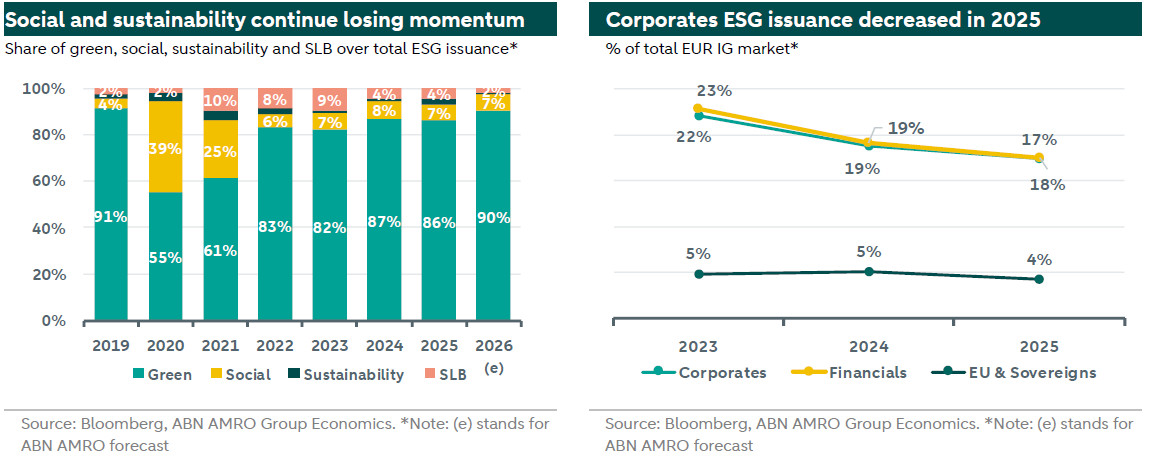
In 2025, Euro-ESG bond issuance fell by 7% compared to 2024, which was slightly sharper than we had expected. This steeper drop likely reflects significant regulatory and political shifts worldwide.
Across the Atlantic, the U.S. saw a reversal in climate policy after President Donald Trump took office in January 2025. The country withdrew from the Paris Agreement, curtailed green project financing, and restricted tax credits.
Within the European Union, several significant policy shifts influenced the ESG market landscape in 2025. Early in the year, the European Commission unveiled its Omnibus proposal, indicating a relaxation of the EU’s climate standards. By the end of the year, the Commission, Council, and Parliament had reached consensus on key aspects of this proposal, most notably agreeing to reduce the number of companies subject to the Corporate Sustainability Reporting Directive (CSRD) by around 90%. Additionally, the European Council struck a last-minute deal to amend the EU Climate Law, introducing a 2040 greenhouse gas (GHG) emissions target alongside new flexibility measures. However, this new 2040 target is less ambitious and offers less clarity than the 2030 objective, potentially allowing for delays and diminishing overall accountability. All these moves have slowed the climate transition and weighed on the ESG bond market growth.
Total Euro-ESG issuance reached EUR 232bn in 2025. Corporates accounted for 38%, financial institutions for 34%, and EU and sovereign issuers for 28%. Corporate issuance declined by 7% year-on-year, while EU and sovereign issuance dropped by 16%. In contrast, financial institutions saw a modest 1% increase.
A breakdown by ESG type showed that green bonds maintained their dominance, representing 86% of the market—virtually unchanged from 87% in 2024. This aligns with findings from our ESG Investor Survey, which confirm investors’ strong preference for green instruments. Social bonds held a 7% share, while sustainability-linked bonds (SLBs) accounted for 4%, both stable compared to the previous year.
Outlook for the Euro-ESG bond market
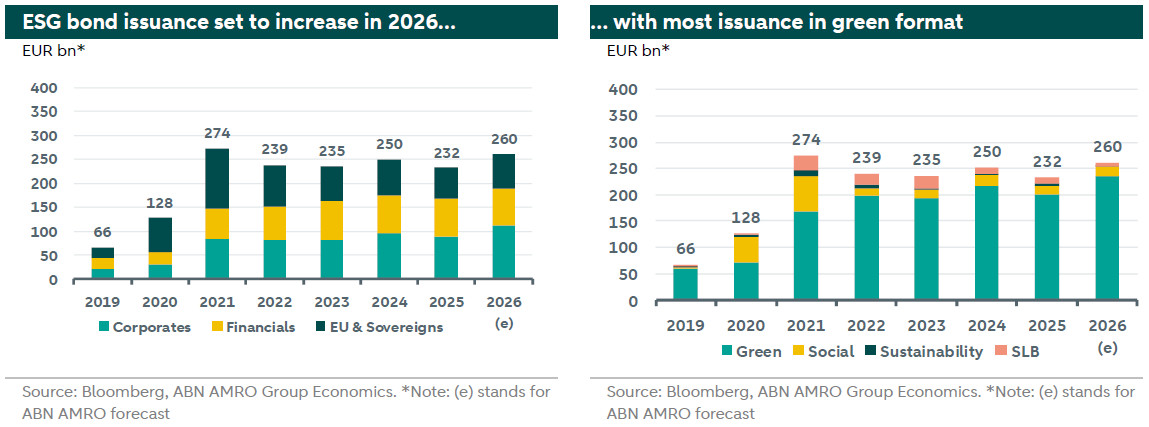
Looking ahead to 2026, Euro-ESG bond issuance is projected to rise significantly—from EUR 232 bn in 2025 to EUR 260 bn. This growth will be driven primarily by increased corporate issuance, particularly from utility companies, alongside higher volumes from sovereign issuers. In contrast, issuance from financial institutions is expected to remain broadly unchanged from last year’s levels.
Several key trends are expected to continue shaping the Euro-ESG bond market. Green bonds are set to maintain their dominance, with their share likely to climb to approximately 90%. Our ESG Survey, conducted in September, indicates that the majority of investors favour use-of-proceeds bonds—such as green and transition bonds—over sustainability-linked bonds, particularly for companies undergoing transformation. The implementation of the Green Bond Standards will further bolster the expansion of the green bond segment. Consequently, we anticipate that social and sustainability bonds will lose additional ground within the EUR IG market. Notably, financial issuers have offered only a small volume of sustainability bonds, while sovereign issuers have yet to embrace this format. Furthermore, the lack of a defined social bond taxonomy is expected to continue constraining the issuance of social bonds.
Financials: issuance to remain stable in 2026
Reflecting on 2025, ESG issuance by financials reached EUR 79 billion, representing 19% of their total issuance. This was roughly in line with previous years, underscoring a steady trend among financial institutions, which appear largely insulated from the shifts that have influenced corporate issuance—a topic we will explore more in detail later. Moreover, issuance conditions remained rather favourable despite geopolitical tensions and heightened financial market uncertainty.
Looking ahead to 2026, we anticipate the share of ESG-labelled bonds issued by financial institutions to remain broadly stable at around 18%. Despite the pressing need to fund the energy transition, overall issuance from financials is expected to hover near EUR 78 billion. Within this total, 26% will be covered bonds, 27% senior-preferred (SP), 38% senior non-preferred (SNP), and the remaining 9% capital instruments, merely Tier 2 bonds.
However, the ESG share varies significantly by asset class. For covered bonds, with total issuance forecast at EUR 160 billion, ESG bonds should represent 13%. For senior-preferred bonds, issuance is projected at EUR 85 billion, of which EUR 22 billion will be ESG—about 26%. Senior non-preferred bonds are expected to total EUR 150 billion, with EUR 31 billion in ESG format (21%). Finally, capital instruments (AT1 and Tier 2) should reach EUR 60 billion, with ESG bonds making up roughly 8%.
Corporates: higher issuance from utility companies
As previously noted, we expect euro IG ESG issuance from corporates to rise by an impressive 24% in 2026, increasing from EUR 89 billion to EUR 110 billion. This growth will be driven primarily by the utilities sector, a cornerstone of the energy transition.
2025 was challenging for utilities, with headwinds such as setbacks in U.S. renewable energy development, the need for equity funding, and persistent issues related to blackouts and grid instability. However, looking ahead we project utilities’ issuance to surge by nearly 40%, from EUR 40 billion last year to EUR 56 billion this year. This anticipated increase reflects several factors: expected dividend payments, substantial capex investments—which may even be underestimated—and FFO projections for 2026.
However, this projection excludes equity injections given how difficult it is to forecast those. Furthermore, there are significant risks that equity funding may not materialize as anticipated by the market. Consequently, issuance could be lower if equity remains a key financing tool for European utilities. For example, SSE recently announced plans to raise GBP 2 bn in additional equity in 2026.
For other sectors, including real estate, we expect issuance to rise on the back of higher refinancing needs. Finally, only a limited number of utility issuers are likely to use the SLB format. While we anticipate growth in the SLB market, the trend of issuers favouring the green label to finance transitional activities is expected to provide stronger support for the green bond market rather than SLBs.
Sovereigns & EU: sovereigns to boost ESG issuance
Within the EU sovereign sector, we project total ESG issuance to reach EUR 61 billion in 2026. Historically, the “big six” countries—Germany, France, Italy, Spain, the Netherlands, and Belgium—have accounted for roughly 85% of this amount, which translates to an estimated EUR 52 billion this year. Germany alone has signalled plans to issue between EUR 16 billion and EUR 19 billion in green bonds, representing 34% of the combined issuance from the Big Six. Notably, the Netherlands has not announced any green issuance for 2026. Nonetheless, given their track record of allocating around 10% of their issuance to green bonds, we expect a portion of their anticipated EUR 50 billion total to be in green format—likely between EUR 2 billion and EUR 4 billion, or approximately 8% of the Big Six’s aggregate. The remaining countries have yet to disclose specific green bond targets, so we anticipate their issuance will be broadly in line with previous years.
For the EU, the European Commission projects overall issuance of EUR 175 bn in 2026—a 25% increase compared to 2025. While the Commission’s target is to allocate up to 30% in green format, historical trends suggest this will not exceed 6%. Accordingly, we expect around EUR 11 bn in green bonds from the EU, similar to last year.
Taken together, sovereigns and the EU should deliver approximately EUR 72 bn in green issuance for 2026.